Why I read the research
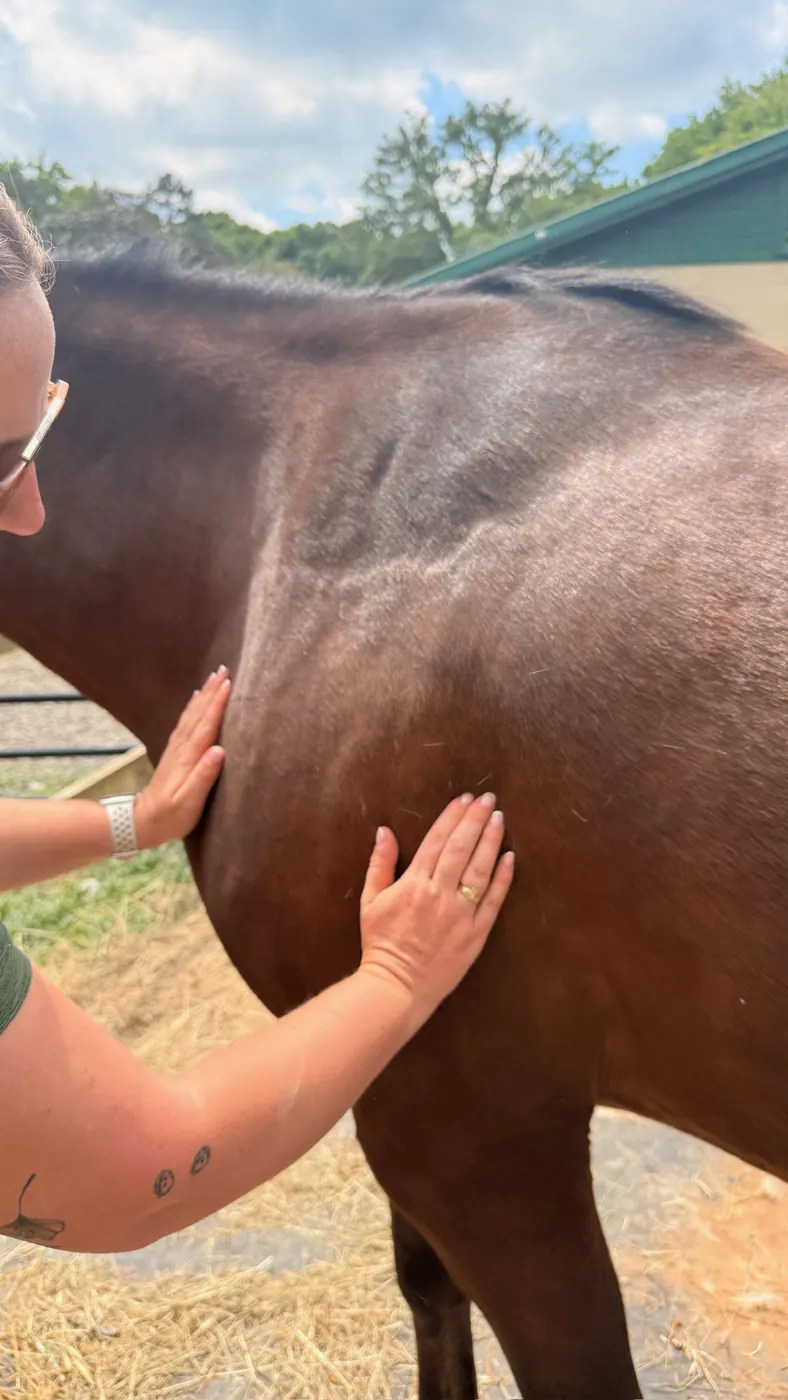
Bodywork is full of big claims. I want to be able to point to the anatomy behind what I do and be honest about where the evidence is thin. These five studies come from my Freely Forward Bodywork training. Each one changed how I look at a horse.
1. The back and the hip work as a team
Researchers put small sensors on horses' skin to record when two big muscles fire at the walk and trot: the longissimus dorsi, the long muscle along each side of the spine, and the gluteus medius, the large muscle over the hip. Both fired in clear, repeatable patterns with each stride. The longissimus works mostly as a stabilizer, holding the spine steady, while the gluteus medius supplies the push at the trot.
Why it matters to me: when I find tension in one of these muscles, I check the other. A sore back and a tight hip are often the same story told in two places.
St. George, L., et al. (2021). Surface electromyographic activity of the gluteus medius and longissimus dorsi muscles in horses during overground walking and trotting. Journal of Equine Veterinary Science. Read the abstract
2. Hind leg muscles are built for different jobs
This study measured the muscle fibers in the horse's hind limb and sorted them by design. The big muscles up top, like the gluteus medius and the hamstrings, have long fibers built for power and range of motion. The muscles lower down have short fibers and long tendons, built to store and release energy like a spring.
Why it matters to me: it tells me what each muscle is supposed to do, so I can spot when it isn't doing it. A restriction in a power muscle shows up differently in the gait than one in a spring muscle.
Payne, R. C., et al. (2005). Architectural design of the pelvic limb muscles of the horse. Journal of Anatomy. Read the study
3. A bigger gluteus medius, a faster horse
Researchers used ultrasound to measure the thickness of the gluteus medius in Quarter Horses that compete in speed events like barrel racing. Horses with a thicker gluteus medius scored better.
Why it matters to me: the gluteus medius is the largest muscle in the horse and the main engine for pushing off. Keeping it healthy and supple matters, and when it is tight or sore, it is no surprise to see power drop. (More in The hind end is the engine.)
Aguiar, J. M., et al. (2018). Morphometric evaluation of the gluteus medius muscle and its relation with performance in Quarter Horses. Arquivo Brasileiro de Medicina Veterinária e Zootecnia. Read the study
4. The neck muscles behind self-carriage
This study looked at two muscles along the top of the neck, the splenius and the semispinalis capitis. They are built differently, but both work with the nuchal ligament to lift, lower and turn the head and neck. The splenius has a large share of fast-twitch fibers, about 40 percent, which tire more quickly.
Why it matters to me: the splenius plays a big part in flexing at the poll and bending the neck. When it gets tired or tight, I often hear about a horse who loses self-carriage or feels heavy in the hand. (More in Poll, jaw and contact.)
Gellman, K. S., et al. (2001). Morphology, histochemistry, and function of epaxial cervical musculature in the horse (Equus caballus). Journal of Morphology. Read the study (PDF)
5. The muscle that holds your horse up
A horse's front legs aren't attached to the spine by bone. The trunk hangs between them in a sling of muscle, and the serratus ventralis is a big part of it. This study found that its fibers are short and packed between thick sheets of connective tissue, built for strength and shock absorption more than for movement.
Why it matters to me: when this muscle is restricted, often from saddle fit or bracing, the horse drops onto the forehand and shortens its stride. Treating it can help a horse lift through the withers again. (More in The thoracic sling.)
Payne, R. C., et al. (2005). The role of the extrinsic thoracic limb muscles in equine locomotion. Journal of Anatomy. Read the study
An honest look at PEMF
I use PEMF (pulsed electromagnetic field therapy) because I see horses relax under it, and it lets me support areas I can't spend as long on with my hands.
Here is how I think about it. PEMF doesn't heal anything on its own. The idea is that it encourages blood flow to the area I'm working on, and blood is the body's own way of healing itself and letting go of tension. PEMF just gives that natural process a nudge. The blood does the real work.
I also want to be straight with you about the research. The studies on PEMF in horses are still few and small. A 2026 pilot study in six mares found short-term changes that people noticed, but no measurable change in gait symmetry. That is one small study, and it doesn't settle the question either way. It does mean I won't promise you that PEMF will fix a lameness or reduce inflammation.
PEMF pilot study (2026). PubMed listing
These summaries are mine, written for horse owners. They are not medical advice. If your horse is lame or in pain, call your vet first.
Questions about your horse?
Tell me what you're noticing and I'll call or text within 24 hours.
Get in Touch