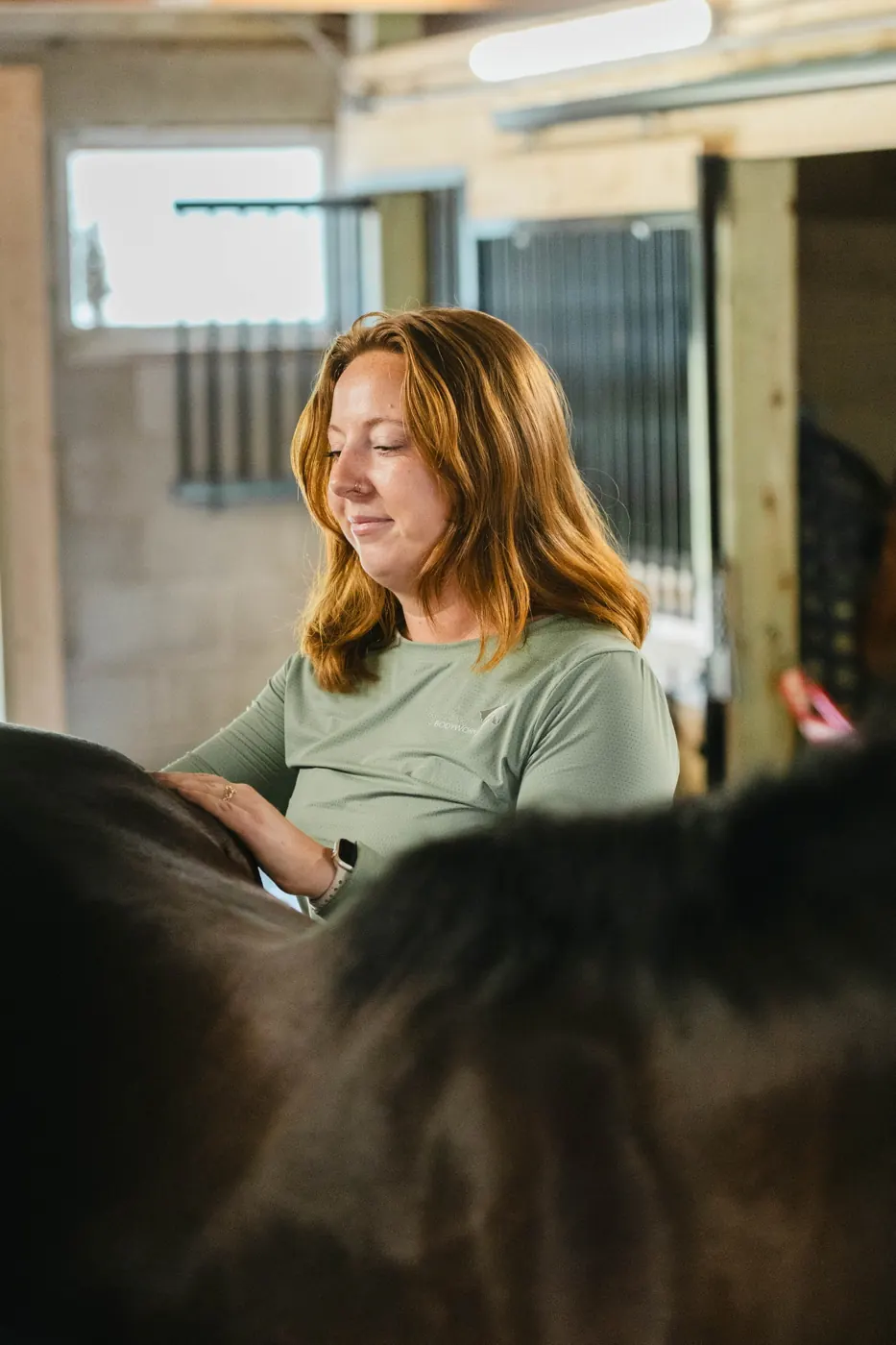
No collarbone
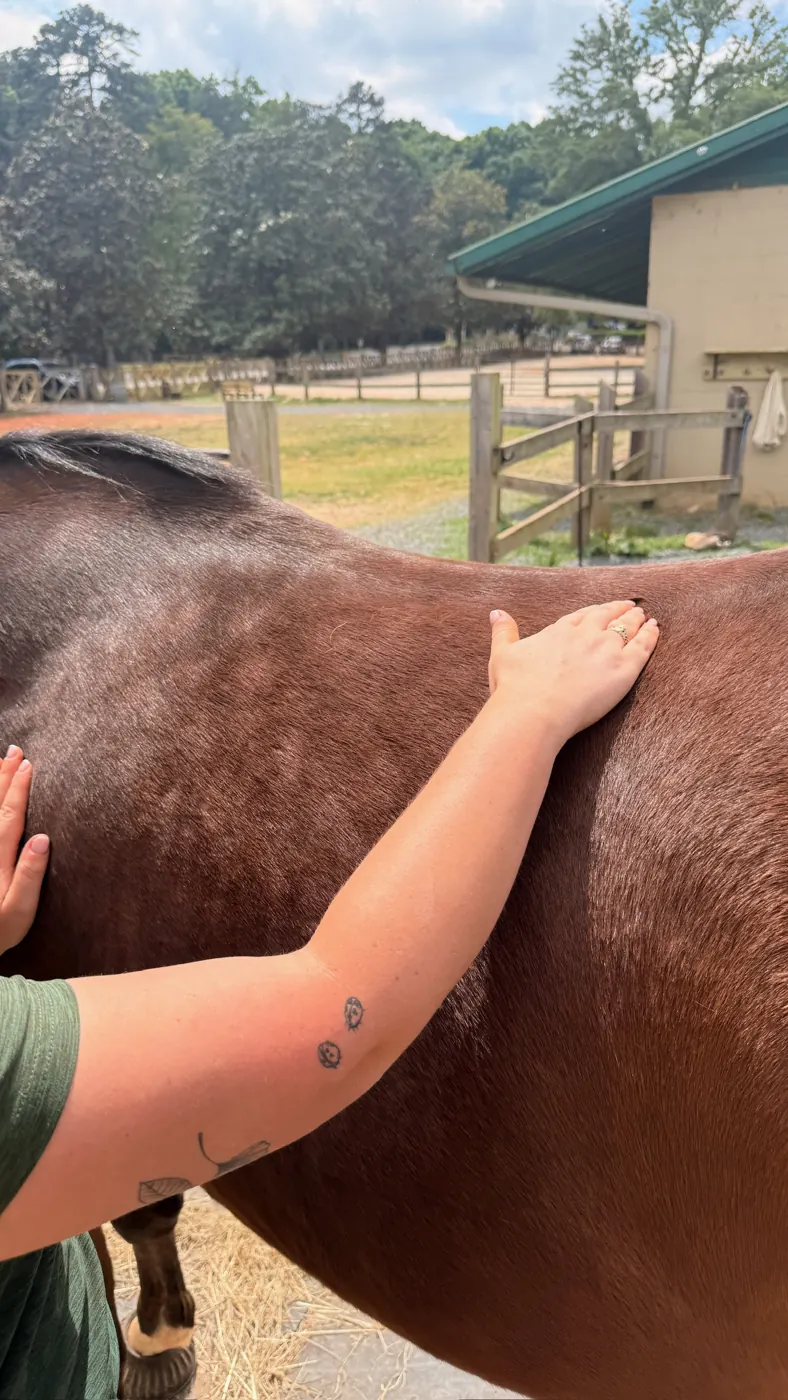
Unlike us, horses don't have a collarbone. Nothing bony connects the front leg to the body. Instead, the front limb and shoulder blade are held on by a group of muscles that wrap around the rib cage and hold the trunk up between the front legs. Together they're called the thoracic sling.
That sling does two big jobs at once: it carries the weight of the front of the horse, and it absorbs the shock every time a front foot hits the ground. It also helps move the leg forward and back. So when something in the sling is tight or sore, you feel it in both comfort and movement.
The muscles in the sling
- Pectorals. Three muscles across the chest that suspend the trunk and keep the shoulder stable. Tension here is one of the most common reasons a horse is girthy.
- Serratus ventralis. A fan of muscle under the shoulder blade that acts as the main suspension for the trunk. It's built more for carrying load than for moving, so when it's restricted, the horse gets heavy on the forehand.
- Rhomboid and trapezius. They lift and stabilize the shoulder blade. The thoracic part of the trapezius sits right under the front of the saddle, so it's often sore or even wasted away when a saddle pinches.
- Triceps and latissimus dorsi. They swing the leg and power each stride. Tight triceps can make a horse girthy and short in front. The latissimus runs from the shoulder back along the ribs, so tension there shows up as mid-back soreness too.
What it looks like from the ground and the saddle
- Pinning ears, biting, or swinging the head when you do up the girth
- A short, choppy front stride, or a "stabbing" step that doesn't reach
- Feeling heavy in front, or struggling with lateral work on the forehand
- Cold-backed when first mounted, or stiff on a circle
- Uneven muscle behind the withers, or hollows on either side of them
Conformation, the sling, or something else?
Not every short front stride is muscle. An upright shoulder naturally makes a shorter, choppier stride, and that's conformation, not something bodywork can change. A sloping shoulder has more reach. Part of my evaluation is sorting out whether I'm looking at the shoulder a horse was born with or tension that's holding it back.
And girthiness isn't always the sling either. Ulcers and gut discomfort often show up as sensitivity around the girth and flank. If I suspect that, I'll tell you it's worth a conversation with your vet.
Saddle fit is part of the picture
Because so many of these muscles sit right under the front of the saddle, a saddle that pinches, bridges, or sits too far forward keeps them guarding. Bodywork can release that tension, but it comes back if the saddle keeps causing it. When I see the pattern, I'll suggest having a qualified saddle fitter take a look.
Sources: ABC of the Horse Atlas (P. Gronberg), How Your Horse Moves (Gillian Higgins), Equine Science (Zoe Davies), Payne et al. (2005), "The role of the extrinsic thoracic limb muscles in equine locomotion," Journal of Anatomy, and my Freely Forward Bodywork certification coursework.
Questions about your horse?
Tell me what you're noticing and I'll call or text within 24 hours.
Get in Touch