Meet Cooper
Cooper is a 9-year-old Quarter Horse who has done a little bit of everything. He started as a cutting horse, now does hunters, and is ridden five to six days a week by both beginners and advanced riders in my lesson program. He has the personality of a classic happy, goofy, puppy dog gelding.
His riders brought me three concerns: weak, "jumpy" transitions, stiffness when asked to bend, and a camped-out posture, where he stood with his hind legs parked out behind him. They also mentioned he was resistant to back up and quick in the canter. His previous owner had done yearly stifle injections.
What I found
Cooper never showed the classic signs of pain. No ear pinning, no biting, no bucking. He stayed calm and kind the whole time, which is exactly why his body had to do the talking.
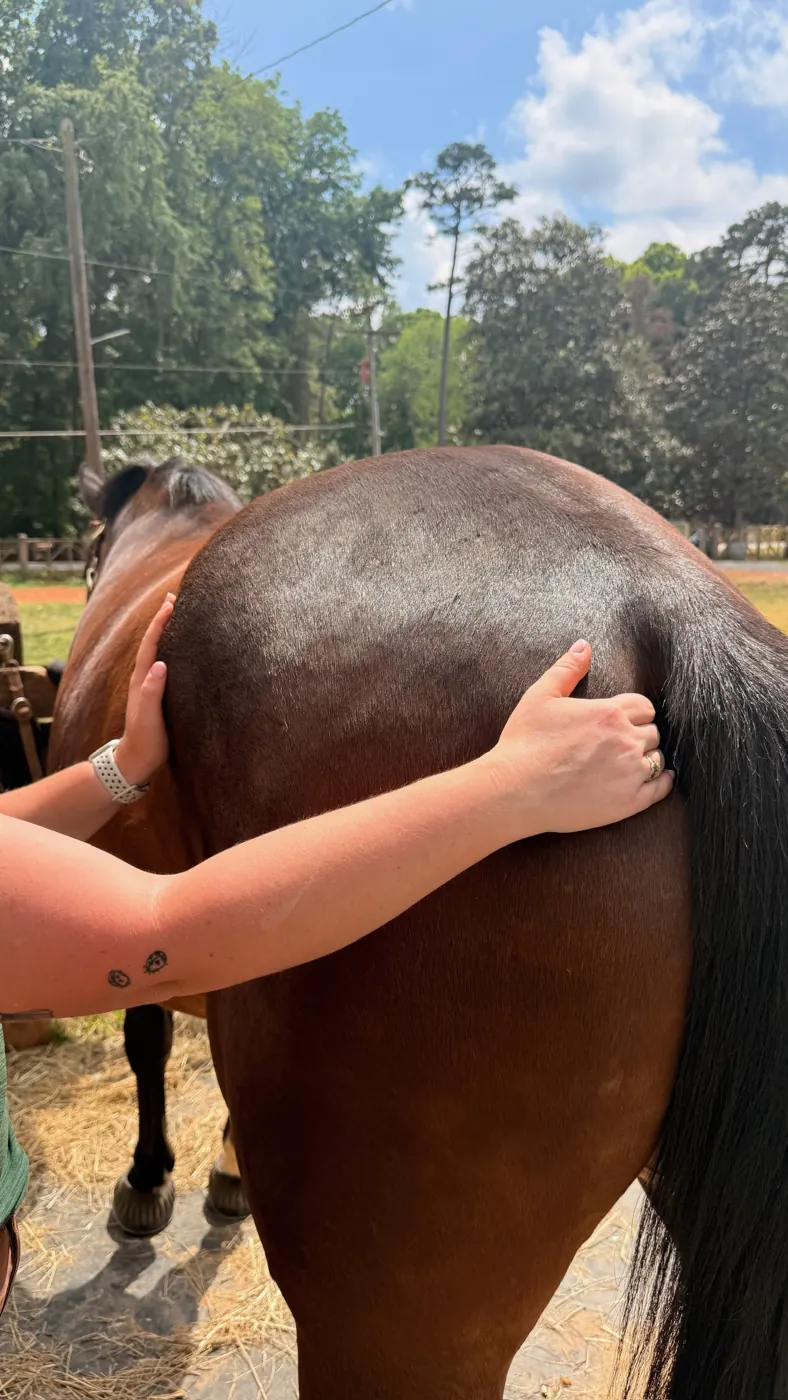
When I first palpated him, his thoracolumbar fascia was very dense and restricted. The tissue through his back, lumbar region and hindquarters was hard and sore. He took short steps with both his front and hind limbs, without moving freely forward and back.
That lined up with what I know about how horses move. The lumbosacral junction is where the pelvis flexes so the horse can load his hind limbs and send power forward. Cooper couldn't load through his pelvis, so he stood camped out to take pressure off his lower back, and that posture only kept the cycle going. His front end was doing the work in his transitions, which is why he popped up into the trot instead of pushing from behind. (More on this area in The hind end is the engine.)
The first three sessions
I focused on his back and lumbosacral region with myofascial release. In the very first session, I could feel the tissue "popping" and releasing under my hands as I worked. His hind end range of motion improved a little by the end, but there was no change yet in his ridden work, and he still hollowed his back at the trot.
After the second session, his hind limbs reached further forward, and the fascia over his back kept softening. His riders still didn't feel a difference.
After the third, his posture had noticeably improved. His hind legs were easier to lift, and the tissue in his lumbar region was softer and more pliable. With experienced riders, he carried himself better and engaged his hind end. He was more willing to back up, though he still popped up in the walk to trot transition.
One thing surprised me: Cooper loved work on his neck and shoulders. I had to learn to split my time between what my biomechanical instincts said (his lumbosacral region) and what he was asking for (his front end). PEMF helped here, because I could run it over an area I was spending less time on with my hands.
A diagnosis that changed the picture
A few months in, Cooper began showing front end soreness, and his vet diagnosed him with navicular. With the right farrier care, he made great progress, and his improvement actually sped up after that.
During his diagnosis and early treatment, I supported him with myofascial release in his front limb extensors, triceps and pectorals to relieve the tension his body had built up around that pain.
It also made me look back at his whole story. Did his hind end trouble lead him to overuse his front end, and that led to heel pain? Did he brace through his neck to avoid heel pain, which then hollowed his back? Or are they separate problems? I may never know. What has been clear is that bodywork alongside his vet and farrier care has given Cooper a lot of relief.
Ten months later
I have kept working with Cooper for ten months. He very rarely stands camped out now. When he does, that is usually my sign it is time for a session or some PEMF.
His walk to trot transitions have improved a lot. With an advanced rider who warms him up and supports him, he transitions smoothly. With beginners, he will still jump into it sometimes. What encourages me most is how he moves through his back now. He no longer hollows and throws his head up. He engages his core, lifts through his thoracic sling and pushes from his hind end.
What Cooper taught me
- A horse can be in real discomfort and still be sweet about it. Look at how they move, not only how they behave.
- Bodywork works best as part of a team. His vet and farrier found what I couldn't.
- Progress is not a straight line. Three sessions in, his riders felt little. Ten months in, he is a different horse.
Next time, I would spend more time on his thoracic sling. He always responded well when I worked there, and I am curious what it would add.
Shared with permission. Bodywork supports veterinary care and never replaces it. If your horse shows lameness or sudden changes, call your vet first.
Questions about your horse?
Tell me what you're noticing and I'll call or text within 24 hours.
Get in Touch