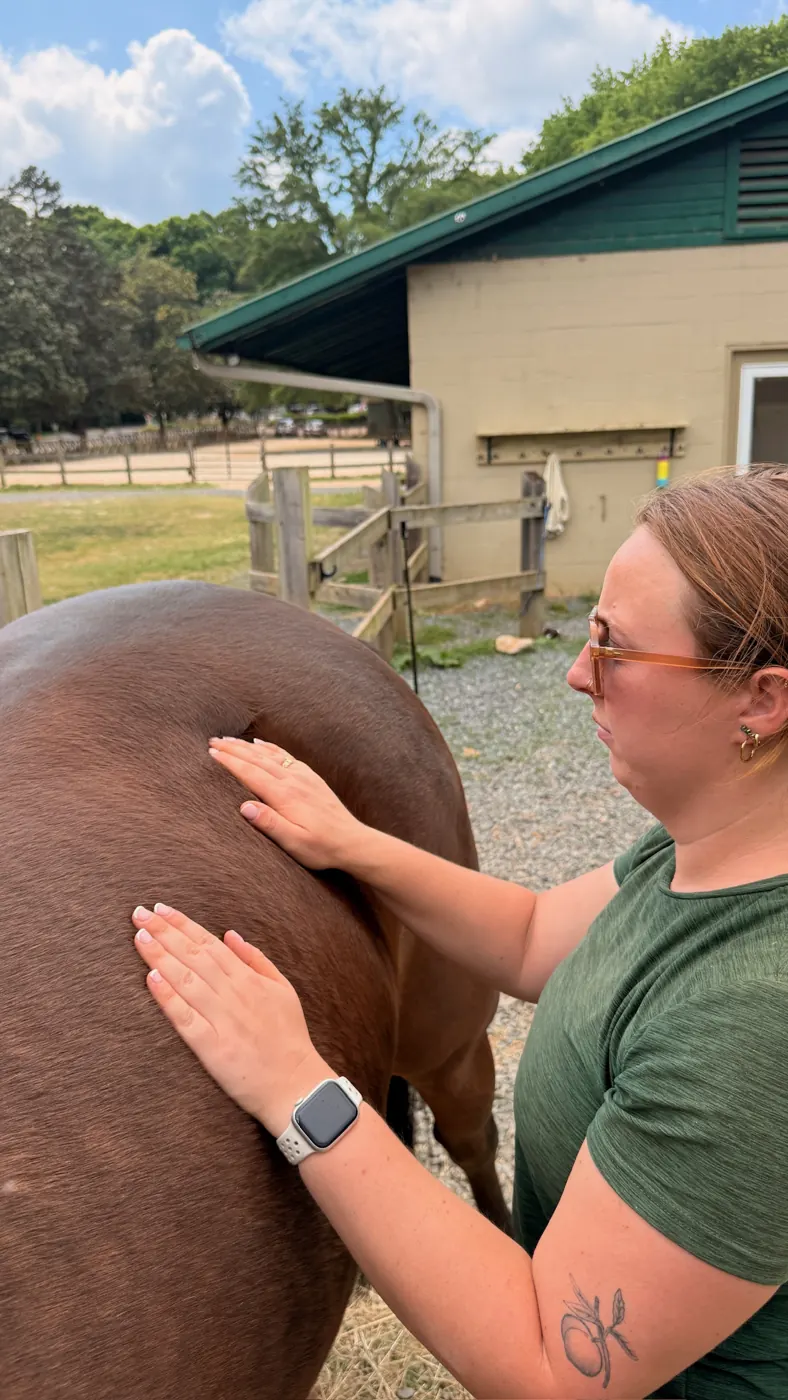
Meet Maggie
Maggie is an 18-year-old Percheron cross who competed through second level dressage and now teaches lessons. She is ridden five to six days a week, mostly walk and trot, with some canter and small jumps up to two feet. She came into my program with an old, unspecified hind end injury and a habit of bucking at the canter. The bucking stopped over the past three years, but she still shook her head and rushed in her transitions.
Overall she is a happy, healthy horse. Unlimited forage, a diet set with a nutritionist, barefoot, and a saddle that fits well.
What her riders noticed
Maggie behaved very differently depending on direction. When she changed from right to left, she would lose her forward momentum, try to turn back around, shake her head, or pull hard on the reins. Her trot to canter transitions were rough, often with head shaking or a squeal.
Behavior like that in upward transitions usually means the horse can't push from behind the way she wants to. That sent me straight to her pelvis and hindquarters, the engine of the horse.
What I found
When I evaluated her standing and moving, her right hip sat high. Her pelvis was out of balance, likely tied to that old injury. I found restricted range of motion in her left hind, pain in her left gluteal muscles, and tightness through her back where she was working to stabilize herself. Bending to the left was very limited.
It all fit together. The pelvis affects the whole body. Her left hind was weaker and less stable, so it couldn't support her through a left bend or push her up into the canter. That, in turn, limited the muscles that bend her back and rib cage.
Three sessions
Session one. Her tissue softened and released, and her pelvis looked more even standing still. In motion, the imbalance was still there. Her riders said she was more willing to move forward, but still struggled to the left.
Session two. After pelvic traction, her balance improved significantly on re-evaluation. Under saddle she was happier, more forward and more balanced, with timely, pleasant transitions.
Session three. Her body responded and released faster than before. After tractioning her pelvis again, the improvement held, and she palpated more comfortable through her back and hind end. Her riders reported no discomfort tracking left.
What didn't change
Maggie still stands with poor posture when she is groomed: not square behind, and without engaging her core. A subtle imbalance also remained in motion. My honest read is that she needs more core strength and fitness to hold onto what the bodywork gives her.
So the next step isn't more bodywork alone. I would want her owner to bring in a trainer to build her core and a saddle fitter to keep checking fit as her body changes. Bodywork plus those two is what makes progress last.
What Maggie taught me
- A horse who is fit and healthy for her age often responds quickly. Maggie's tissue did what I expected it to.
- Trouble in one direction is worth looking at from behind. The problem showed up in her head and rein, and started in her pelvis.
- Experienced horses stepping down to lighter work keep old compensation patterns. They deserve a plan, not just a lighter schedule.
Shared with permission. Bodywork supports veterinary care and never replaces it. If your horse shows lameness or sudden changes, call your vet first.
Questions about your horse?
Tell me what you're noticing and I'll call or text within 24 hours.
Get in Touch