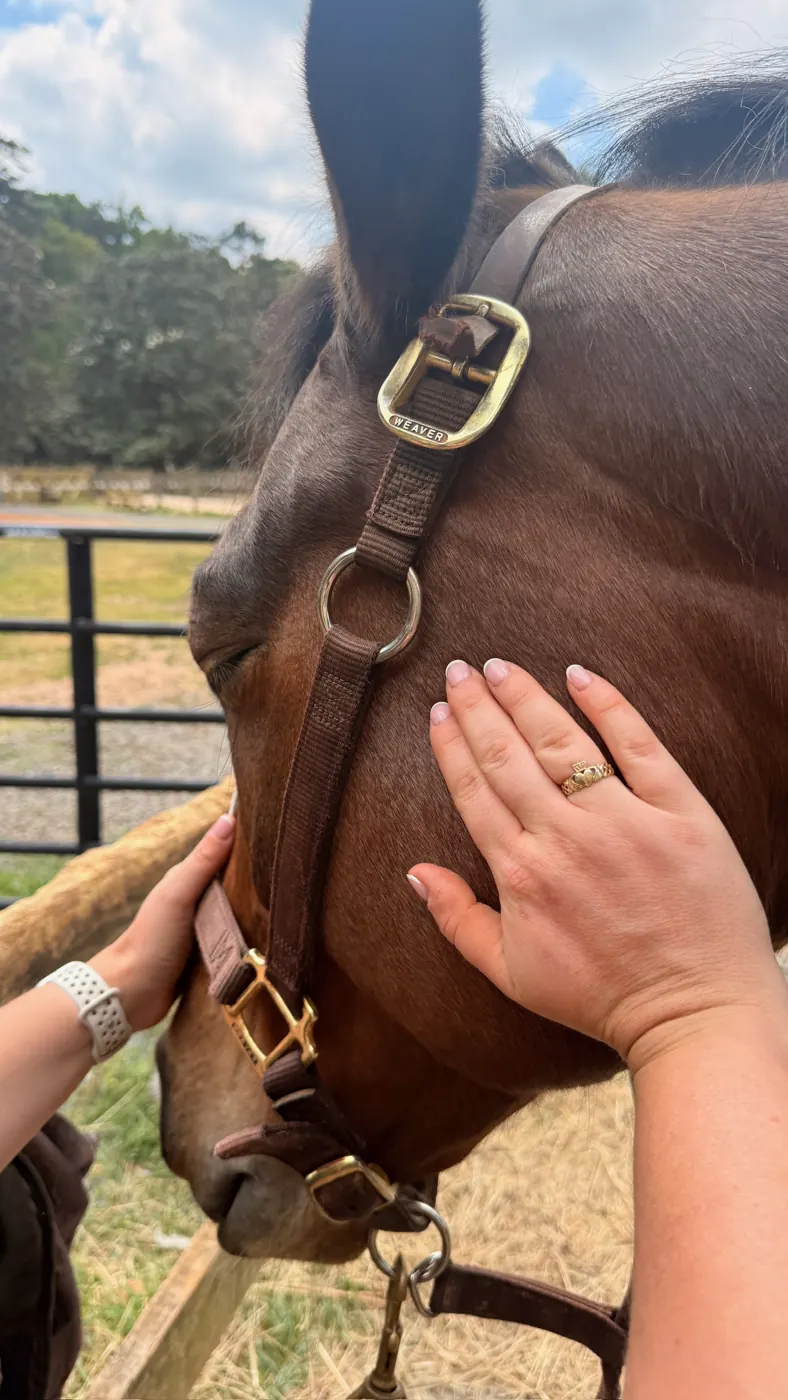
Meet Darcy
Darcy is an appendix Quarter Horse in his twenties, all 17 hands of him. He started his career as a futurity hunter under saddle horse on the AQHA circuit, then showed in the all-around. His owner stopped paying for him and he was left at the barn where he was training. He was donated to St. Andrews University for their IHSA team, and in 2021 he was donated again, to the YMCA Camp Thunderbird lesson program, because he wasn't thriving in a big show barn.
Today he is ridden four to five times a week in walk and trot lessons, with ground work over poles once or twice a week. Since he is in the lesson program I run, I am his main caretaker.
His body tells some of his past. He has scars, a tail that stays lifted from a botched nerving, and an anxious personality. In a bit he sticks his tongue out and shakes his head, so he goes in a hackamore. Good farrier work over five years has turned his flat "pancake feet" around and stopped his tripping. He has unlimited forage, a nutritionist-planned diet and 15 hours of turnout. He is well cared for now.
What I saw
The concerns were limited range of motion in his neck, a reactive back, poor overall muscle tone, and his anxiety. When he is groomed, he needs a hay bag in front of him. Without it, he grinds his teeth and shakes his head. Those are signs of a horse in pain, and my evaluation agreed.
His neck had limited range of motion on both sides, worse to the right. He carried his head and neck low at the trot, a sign of a weak thoracic sling and topline. He was sore through his neck, shoulders, chest and triceps. His hind end was underdeveloped for a horse his size, which puts more of his weight on his front end. I believe that is why his back and shoulders hurt. Under saddle he struggled to balance in the canter, to hold the right lead, and to bend in circles to the right.
Slow and soft
Session one brought no change in flexibility, but he relaxed a lot and became more comfortable with my touch.
At session two, Darcy was irritable and didn't want to be touched. So I switched to PEMF over his body. After 45 minutes he was much more relaxed, and I did gentle myofascial release on both sides of his neck. His riders said he was softer and happier under saddle.
At session three, he still wasn't comfortable with work on his back, so I stayed with his neck and jaw. He relaxed and released much faster. After that session his riders reported better walk to trot transitions, a more even gait and a stronger, more balanced canter.
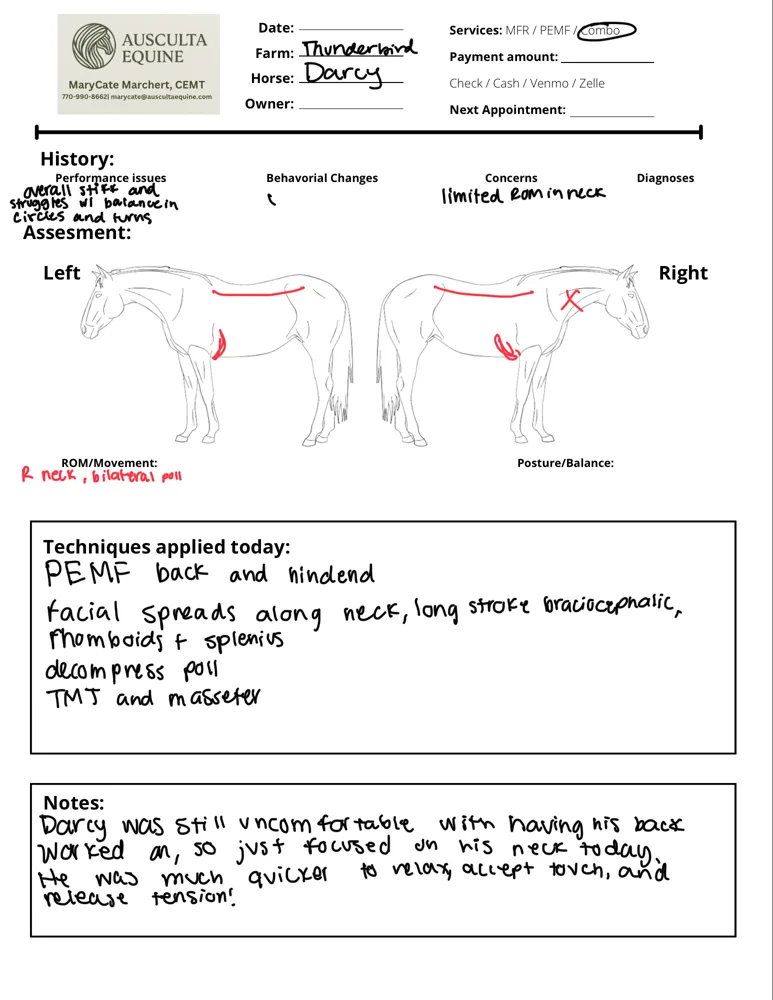
Through all of it, the range of motion in his neck did not improve at all. That told me something else was going on, so I asked our vet to evaluate him.
What the vet found
The vet found a melanoma under the skin just in front of his right shoulder blade. It may be the main thing limiting his bend to the right, and it may be pressing on nerves there and causing him pain. He also tested positive for EPM, which adds to his poor muscle tone and balance.
Together, we made a care plan with the vet that includes more PEMF and myofascial release, for relief and relaxation.
What Darcy taught me
The biggest change I made with Darcy was in my own mindset. He had so much going on, and I wanted to fix all of it. Two decades of damage can't be undone in a few sessions. I had to come in softer each time and follow his lead on what work he wanted.
Even so, slow, gentle work made a difference he could feel, and his riders could see. That encouraged me to listen to the horse no matter what.
Darcy is also my reminder to be honest with every client. There can be pressure to produce dramatic before and after results, and that pressure should never come before the horse's welfare. Bodywork has limits. It can't undo years of poorly fitting tack or hard training. But the relief it brings can still be life changing for a horse like him.
When a horse is uncomfortable or reactive, I step back. And when something isn't changing, I call the vet.
Shared with permission. Bodywork supports veterinary care and never replaces it. If your horse shows lameness or sudden changes, call your vet first.
Questions about your horse?
Tell me what you're noticing and I'll call or text within 24 hours.
Get in Touch